
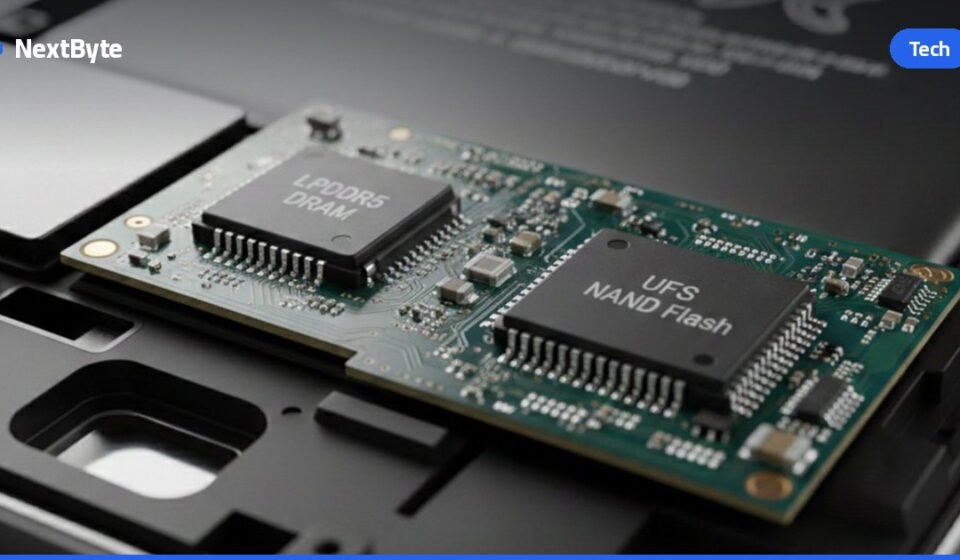

Smartphone memory costs have undergone a dramatic shift in the mobile industry’s economics. According to a tipster’s latest estimations, the combined price of DRAM and NAND flash has become 340 percent more expensive than it was just a year ago—and now costs more than a top-end system-on-chip (SoC). This reversal marks a significant departure from the era when advanced chipsets were reliably the costliest component inside a phone.
How smartphone memory costs climbed past premium chips
The numbers tell a striking story. Last year, a pairing of 12GB of RAM and 256GB of storage would cost manufacturers around $70. According to Digital Chat Station, by Q3 2026 that same configuration has surged to 2,200 RMB, or approximately $310. Meanwhile, premium smartphone chipsets—despite moving to cutting-edge processes like TSMC’s 2nm technology—now sit at around 2,000 RMB, or $280. Smartphone memory costs have effectively overtaken the silicon itself as the second-largest expense in a phone’s bill of materials.

The pressure intensifies when manufacturers choose higher-tier configurations. Stepping up to 16GB of RAM paired with 256GB or 512GB of storage creates a substantially larger impact on the overall BOM (Bill of Materials), forcing companies to raise retail prices accordingly. This constraint has already shaped real-world product decisions: some of Google’s newest Pixel 11 Pro models now ship with 12GB of RAM instead of 16GB, and they’re priced higher than the Pixel 10 Pro despite the memory reduction.
Why Apple has an advantage in the smartphone memory costs race
Not all manufacturers face the same pressure. Apple designs its own chipsets and has TSMC manufacture them, avoiding the licensing fees that Android makers like Qualcomm and MediaTek customers must pay. This vertical integration has given Apple a structural cost advantage—though the company remains vulnerable to DRAM shortages just like everyone else. As covered earlier, Nvidia Details Groq 3 LPX Architecture and First Third-Party Benchmarks highlighted how architectural choices in chip design continue to shape the competitive landscape.
Looking ahead, smartphone memory costs are expected to continue climbing through 2028, though analysts suggest the shortage cycle could begin to ease sometime in 2029. In a related development, Samsung Galaxy S26 FE vs S25 FE: Explaining the $50 Price Increase showed how memory constraints are already forcing manufacturers to make difficult trade-offs between specifications and pricing, a pattern likely to persist until supply stabilizes.
المصدر: Wccftech